

News & Events
2025-03-20
Project Meeting – Task C AI-Enabled digital twin coast for Hong Kong (HKCT)
Room 3574, Academic Building, HKUST
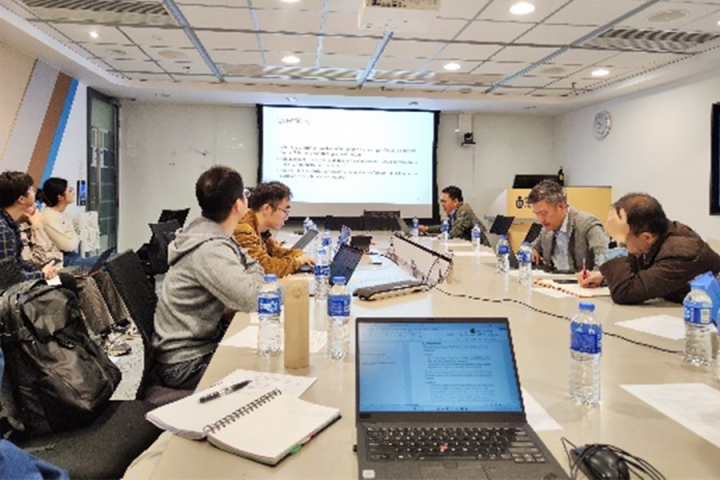
The AI-Enabled HKCT team for T22-607/24N held a meeting on 20 March 2025. Attendees included PC Prof. Jidong Zhao, Co-PIs Profs. Xiaofang Zhou, Quanmin Qu, Zhenyu Yin, and Can Yang, along with their research postdocs and students. Additionally, Prof. Mengqian Lu’s group was represented by Dr. Lun Dai and Mr. Hanzhe Cui (totaling 25 participants).
A total of 5 talks were given. Prof Can Yang discussed recent AI advances for ocean science and coastal hazard prediction. Dr Qintian Guo from Prof Zhou’s group updated their progress regarding the establishment of data management system for the TBS project. Dr Xi Wang from Prof Yin's group presented their work on surrogate Modeling and Data Assimilation of Wave-Structure-Soil Systems Using Physics-Informed Neural Networks (PINNs). Dr Linping Yuan from Prof Qu’s group shared their work on standalone visualization, interactive visualization, and use of visual analytics for decision-making. Dr Lun Dai from Prof Lu group shared their work on AI downscaling and data fusion from multiple sources.
The AI-Enabled HKCT team for T22-607/24N held a meeting on 20 March 2025. Attendees included PC Prof. Jidong Zhao, Co-PIs Profs. Xiaofang Zhou, Quanmin Qu, Zhenyu Yin, and Can Yang, along with their research postdocs and students. Additionally, Prof. Mengqian Lu’s group was represented by Dr. Lun Dai and Mr. Hanzhe Cui (totaling 25 participants).
A total of 5 talks were given. Prof Can Yang discussed recent AI advances for ocean science and coastal hazard prediction. Dr Qintian Guo from Prof Zhou’s group updated their progress regarding the establishment of data management system for the TBS project. Dr Xi Wang from Prof Yin's group presented their work on surrogate Modeling and Data Assimilation of Wave-Structure-Soil Systems Using Physics-Informed Neural Networks (PINNs). Dr Linping Yuan from Prof Qu’s group shared their work on standalone visualization, interactive visualization, and use of visual analytics for decision-making. Dr Lun Dai from Prof Lu group shared their work on AI downscaling and data fusion from multiple sources.
2025-02-23
Project Meeting – Task A1 Digital Model and Monitoring
Room 3574, Academic Building, HKUST
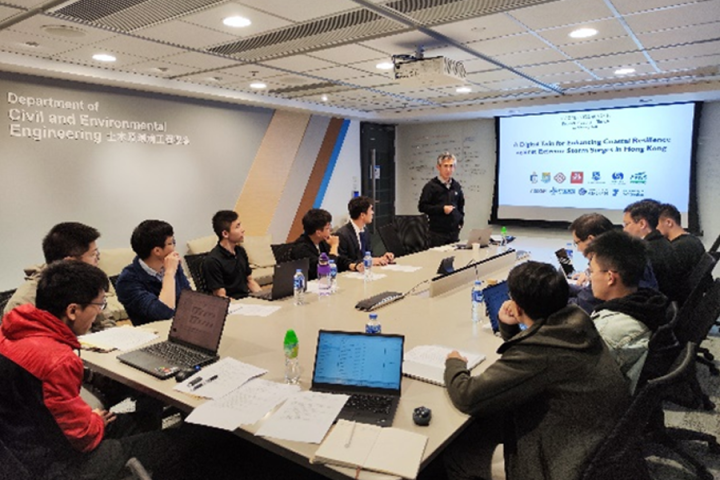
The digital modeling and monitoring team for T22-607/24N met on 23 Feb 2025, consisting of PC Prof Jidong Zhao, Co-PIs Profs. Bo Huang, Jack Cheng, and Alessandro Stocchino, alongside their research postdocs and students working on the project (totaling 21 participants).
A total of 5 talks were given. Prof Bo Huang’s group shared their previous research on using multi-source remote sensing data to assess and detect sea bank overflow risk. Dr Enze Zhang from Prof Hui Su’s group present their work on data fusion of CCMP with satellite data for high resolution and accurate wind field generation based on deep learning model. Prof Jack C P Cheng presents their work on the development of BIM digital platform. Mr Xiaonan Shang from Prof Jidong Zhao’s group present some progress made on the establishment of Hong Kong Digital Coast. Prof Alessandro Stocchino introduced their recent work on the coastal HF-radar network for real time, high spatial resolution coastal circulation, waves and wind monitoring.
The digital modeling and monitoring team for T22-607/24N met on 23 Feb 2025, consisting of PC Prof Jidong Zhao, Co-PIs Profs. Bo Huang, Jack Cheng, and Alessandro Stocchino, alongside their research postdocs and students working on the project (totaling 21 participants).
A total of 5 talks were given. Prof Bo Huang’s group shared their previous research on using multi-source remote sensing data to assess and detect sea bank overflow risk. Dr Enze Zhang from Prof Hui Su’s group present their work on data fusion of CCMP with satellite data for high resolution and accurate wind field generation based on deep learning model. Prof Jack C P Cheng presents their work on the development of BIM digital platform. Mr Xiaonan Shang from Prof Jidong Zhao’s group present some progress made on the establishment of Hong Kong Digital Coast. Prof Alessandro Stocchino introduced their recent work on the coastal HF-radar network for real time, high spatial resolution coastal circulation, waves and wind monitoring.
2025-01-15
Project Meeting – Task B2 Computational modeling
Room 5508, Academic Building, HKUST
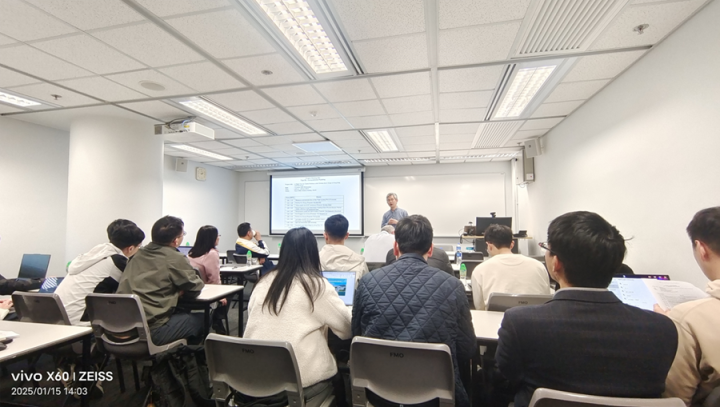
The computational modeling team, consisting of PC Prof Jidong Zhao, Co-PIs Profs. Hui SU, Zhenyu Yin, Alessandro Stocchino, Mengqian LU, Lin FU, and an invited Co-I Prof Jize Zhang, and their research postdocs and students totaling 32, met on 15 January 2025.
A total of 7 presentations were given in this meeting. Ms. Huisi Mo from Prof. Su's team presented atmosphere-wave-ocean coupled simulations of the South China Sea and Great Bay areas using the UWIN-CM model. Dr Hao Chen from Prof Zhao’s team introduced their progress in computational modeling of wave-coastal structure interactions. Prof Yin gave a presentation on Hybrid Particle Element Method (HPFEM) for large deformation and erosion. Prof Lu introduced their work of data fusion and AI-based downscaling. Alessandro introduced what they have done and what they can do in the coastal project. Prof Fu Lin talked about CFD simulations of compressible multiphase flows with phase changes. Jize discussed the use of physics-integrated AI to aid in tropical cyclone modeling.
The computational modeling team, consisting of PC Prof Jidong Zhao, Co-PIs Profs. Hui SU, Zhenyu Yin, Alessandro Stocchino, Mengqian LU, Lin FU, and an invited Co-I Prof Jize Zhang, and their research postdocs and students totaling 32, met on 15 January 2025.
A total of 7 presentations were given in this meeting. Ms. Huisi Mo from Prof. Su's team presented atmosphere-wave-ocean coupled simulations of the South China Sea and Great Bay areas using the UWIN-CM model. Dr Hao Chen from Prof Zhao’s team introduced their progress in computational modeling of wave-coastal structure interactions. Prof Yin gave a presentation on Hybrid Particle Element Method (HPFEM) for large deformation and erosion. Prof Lu introduced their work of data fusion and AI-based downscaling. Alessandro introduced what they have done and what they can do in the coastal project. Prof Fu Lin talked about CFD simulations of compressible multiphase flows with phase changes. Jize discussed the use of physics-integrated AI to aid in tropical cyclone modeling.
2024-09-06
Project Meeting – Kick-off meeting
Lecture Room H, Academic Building, HKUST
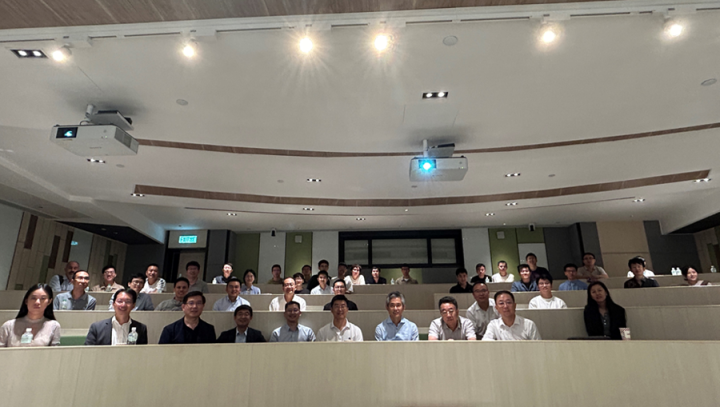
The kickoff meeting held on Saturday successfully brought the team together, with each member gave s short summary outlining their expertise and demonstrating how their research background would contribute to the project's objectives. Both in-person and online participants actively engaged in dynamic discussions that sparked innovative ideas and identified promising collaboration opportunities. Through this exchange of insights and constructive dialogue, the team not only clarified individual roles but also strengthened the overall project framework, setting a solid foundation for future progress. The session effectively achieved its goal of aligning team members while fostering a collaborative environment conducive to innovation.
The kickoff meeting held on Saturday successfully brought the team together, with each member gave s short summary outlining their expertise and demonstrating how their research background would contribute to the project's objectives. Both in-person and online participants actively engaged in dynamic discussions that sparked innovative ideas and identified promising collaboration opportunities. Through this exchange of insights and constructive dialogue, the team not only clarified individual roles but also strengthened the overall project framework, setting a solid foundation for future progress. The session effectively achieved its goal of aligning team members while fostering a collaborative environment conducive to innovation.
Research
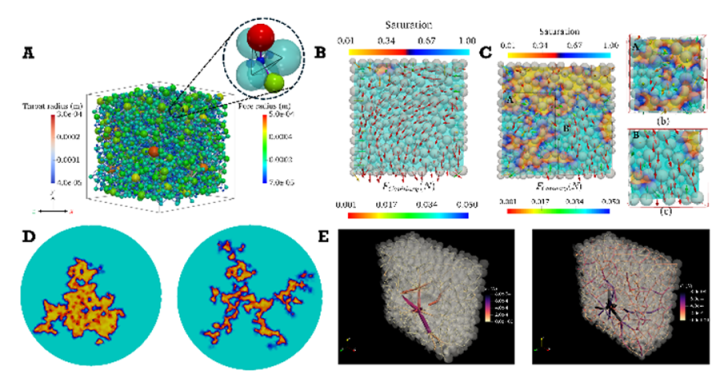
(A) Illustration of PUA-DEM partitioning fluid-solid domains for modeling a triphasic system. Distribution of air-water interfaces and capillary forces juxtaposed on DEM particle. (B) Capillary regime. (C) Funicular regime. (D) Fluid-fluid interface instability, capillary fingering (left) and viscous fingering (right). (E) Force chain evolution in granular medium embedded with swellable material, low confinement (left) and high confinement (right).
This research has garnered significant media coverage, as featured in the following news outlets:
From landslides to pharmaceuticals: High-precision model simulates complex granular and fluid interactions
港科大團隊開發新模型 提升山泥傾瀉預測準確度
精准预测自然灾害!港科大解锁防灾×能源×农业x医疗多重变革
From landslides to pharmaceuticals: High-precision model simulates complex granular and fluid interactions
HKUST Researchers Develop New Model for Accurate Landslide Prediction
科大團隊開發新模型 提升山泥傾瀉預測準確度 應用涵蓋可持續農業、能源及醫療跨領域
This research has garnered significant media coverage, as featured in the following news outlets:
From landslides to pharmaceuticals: High-precision model simulates complex granular and fluid interactions
港科大團隊開發新模型 提升山泥傾瀉預測準確度
精准预测自然灾害!港科大解锁防灾×能源×农业x医疗多重变革
From landslides to pharmaceuticals: High-precision model simulates complex granular and fluid interactions
HKUST Researchers Develop New Model for Accurate Landslide Prediction
科大團隊開發新模型 提升山泥傾瀉預測準確度 應用涵蓋可持續農業、能源及醫療跨領域